
SOOOOOO MUCH WE DON'T YET KNOW . . .
👀 👀 👀 👀 👀 👀 👀 👀 👀
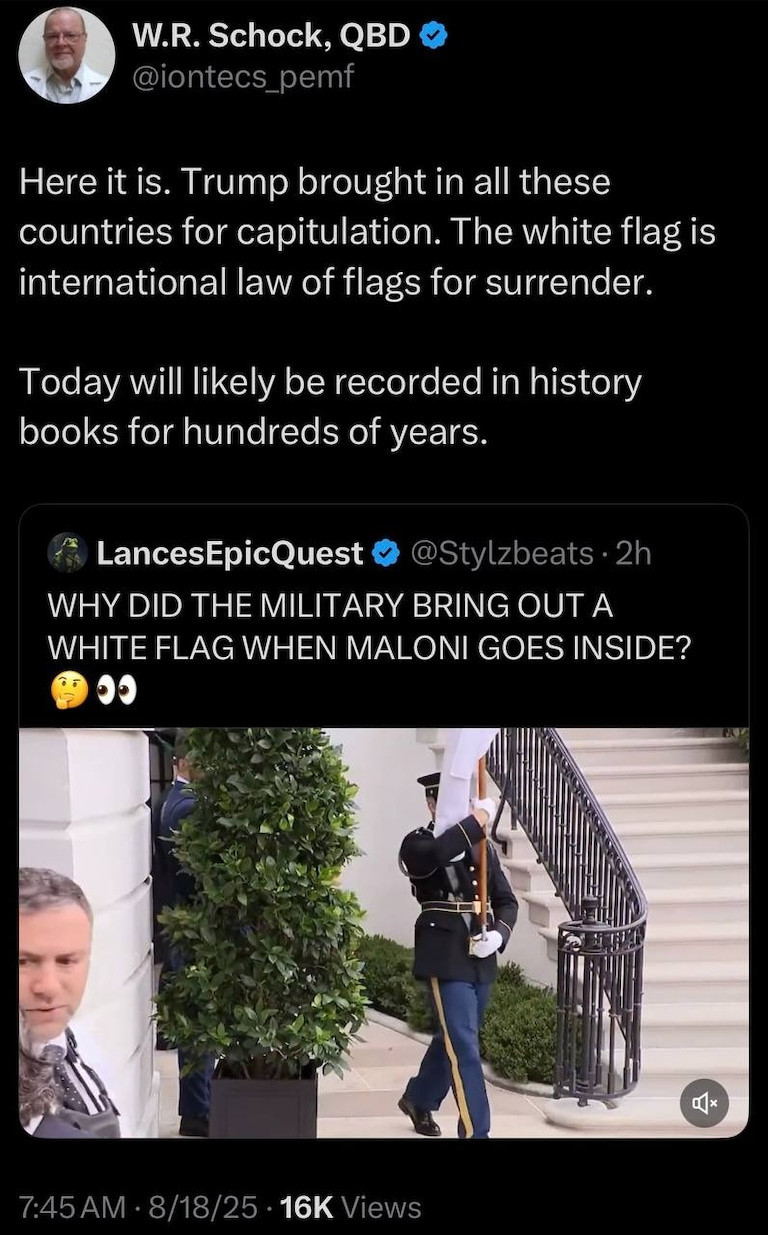

However, the white flag generally signifies a desire to communicate with the opposing side, either to negotiate a truce, surrender, or discuss terms.
Here's a breakdown of the meaning and potential scenarios where a white flag would be displayed by the military:
Request for Parley or Negotiation: It indicates a desire to communicate with the enemy, perhaps to discuss a temporary halt to fighting (a truce or ceasefire) or to negotiate terms of surrender.
Intention to Surrender: This is perhaps the most well-known meaning of the white flag in a military context.
Request for a Truce or Ceasefire: A white flag may also be used to signal a temporary cessation of hostilities for various reasons, such as retrieving wounded soldiers or burying the dead.
The white flag is recognized as a protected symbol under international law (specifically, the Hague Conventions), and the misuse of the flag is considered a war crime.
Trivia
The Italian Flag in WW2
Was a White Cross on a White background
The national flag of Italy during much of World War II, under the Kingdom of Italy, was a green, white, and red tricolor flag with the Savoy coat of arms at the center. The Savoy coat of arms featured a red shield with a white cross, surrounded by a blue border, and typically surmounted by a crown for military use.
It's important to note the nuances:
The flag of the Kingdom of Italy remained the official state flag even with the Fascist regime in power under Benito Mussolini.
For a brief period in the latter part of the war (1943-1945), a German puppet state known as the Italian Social Republic, or Republic of Salò, used a different flag that was essentially the plain Italian tricolor, according to Wikipedia. However, this was a short-lived entity.
While the white cross on a red field is associated with the House of Savoy, and historically was used on flags, it was not the main national flag of Italy during WWII.